
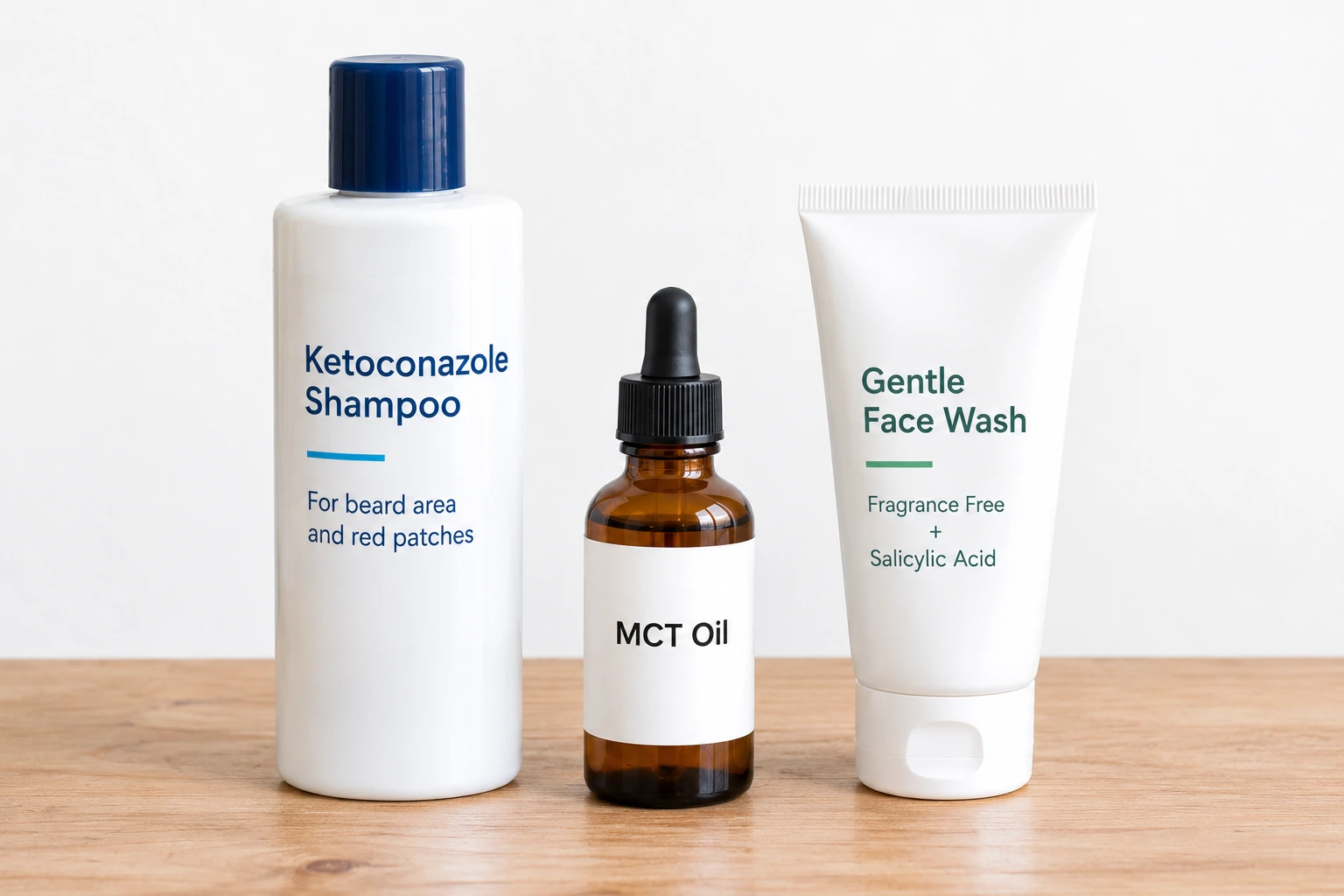

I have been dealing with seborrheic dermatitis for years. I first noticed it on my scalp and have followed a simple routine to calm and manage it. Later, it spread, and now I have it on my face too, especially around my beard.
To manage seborrheic dermatitis on my face, I just use this simple routine that works for me.
I don’t use a lot of products, but only the ones that help me control the symptoms.
My Routine
It’s very simple: I use the Ketoconazole shampoo on my beard area and the red patches where I usually have the problem. I keep it on for 1 to 2 minutes and then rinse it off with water.
I do this on alternate days and also, depending on my skin condition, so at most I wash my face with the shampoo 2-3 times a week.
If you don’t know what Ketoconazole shampoo is, it is an antifungal medicated shampoo and is generally recommended by dermatologists for seborrheic dermatitis.
When I told my dermatologist that I have red patches and flakes on my face too, he recommended that I use the Ketoconazole shampoo on my face (only the affected areas) as well as on my scalp.
Don’t keep the shampoo on for too long, as it can cause irritation on the affected area, so keep that in mind.
After that, I apply MCT oil
To moisturize the area and to prevent any dryness, redness, and flakes, I apply pure MCT oil that contains only capric (C10) and caprylic (C8) fatty acids, to that area.
That’s it; that’s all the routine I follow to manage seborrheic dermatitis on my face, and it works for me very well.
This is my routine and experience, so I can’t say this will work for you exactly the way it worked for me.
So, I would recommend seeing how your skin reacts. Pure MCT oil (containing only capric (C10) and caprylic (C8) fatty acids, without C12 lauric acid) is generally the safest on the skin and also helps to reduce the growth of the yeast Malassezia that is responsible for seborrheic dermatitis, and I would recommend giving it a try.
You Can Also Use a Gentle Face Wash
You can also use a mild, fragrance-free face wash to manage the condition. The American Academy of Dermatology recommends gently washing seborrheic-dermatitis-prone skin and avoiding fragranced products because irritated skin can trigger or worsen flare-ups.
You can also use a cleanser that contains pyrithione zinc. Its antifungal properties help to manage the flakes, and its effect stays even when rinsed off the face or skin due to its fine particles.
You can also look for a gentle cleanser containing salicylic acid. Salicylic acid is a keratolytic ingredient, meaning it helps loosen and remove dead, flaky skin. It can be useful for scaly skin conditions, including seborrheic dermatitis.
Keep it Simple
One thing I have learned while dealing with seborrheic dermatitis is that using various products doesn’t necessarily mean it will make things better.
For me, keeping things simple works the best:
Ketoconazole shampoo → rinse → small amount of MCT oil.
And when I just want to simply clean my face, I use a normal chemical- and fragrance-free face wash.
The goal here for me is not to find the magical product that cures seborrheic dermatitis, as it is a chronic condition; it comes and goes.
I focus on keeping it under control and adjusting my routine when my skin starts acting up.
One more thing
If it works for me, it doesn’t mean it will work exactly the same way for you.
If you have severe redness, swelling, pain, persistent irritation, or you are not sure whether the rash or flakes are actually seborrheic dermatitis, it is better to consult a dermatologist. Other skin conditions can sometimes look similar to seborrheic dermatitis.
For me, though, keeping my routine simple has made taking care of seborrheic dermatitis on my face much easier.