
I have tried different oils, thinking that they would reduce or help with the redness, itching, and dandruff caused by seborrheic dermatitis. They helped with the itching and dandruff but later made the symptoms even worse.
I used to wonder why, and my dermatologist explained that applying oil can make this condition worse because the yeast associated with it, called Malassezia, feeds on oil and sebum and then multiplies, worsening my symptoms.
But how can MCT, or Medium-chain triglycerides oil, work with seborrheic dermatitis? It is an oil, yes, but a different one. Actually, what happens is that the yeast Malassezia feeds on longer-chain fatty acids that specifically contain 11- 24 carbon-atom chains.
And the MCT mainly has four types containing 6 (Caproic acid), 8 (Caprylic acid), 10 (Capric acid), and 12 (Lauric acid) carbon atoms.
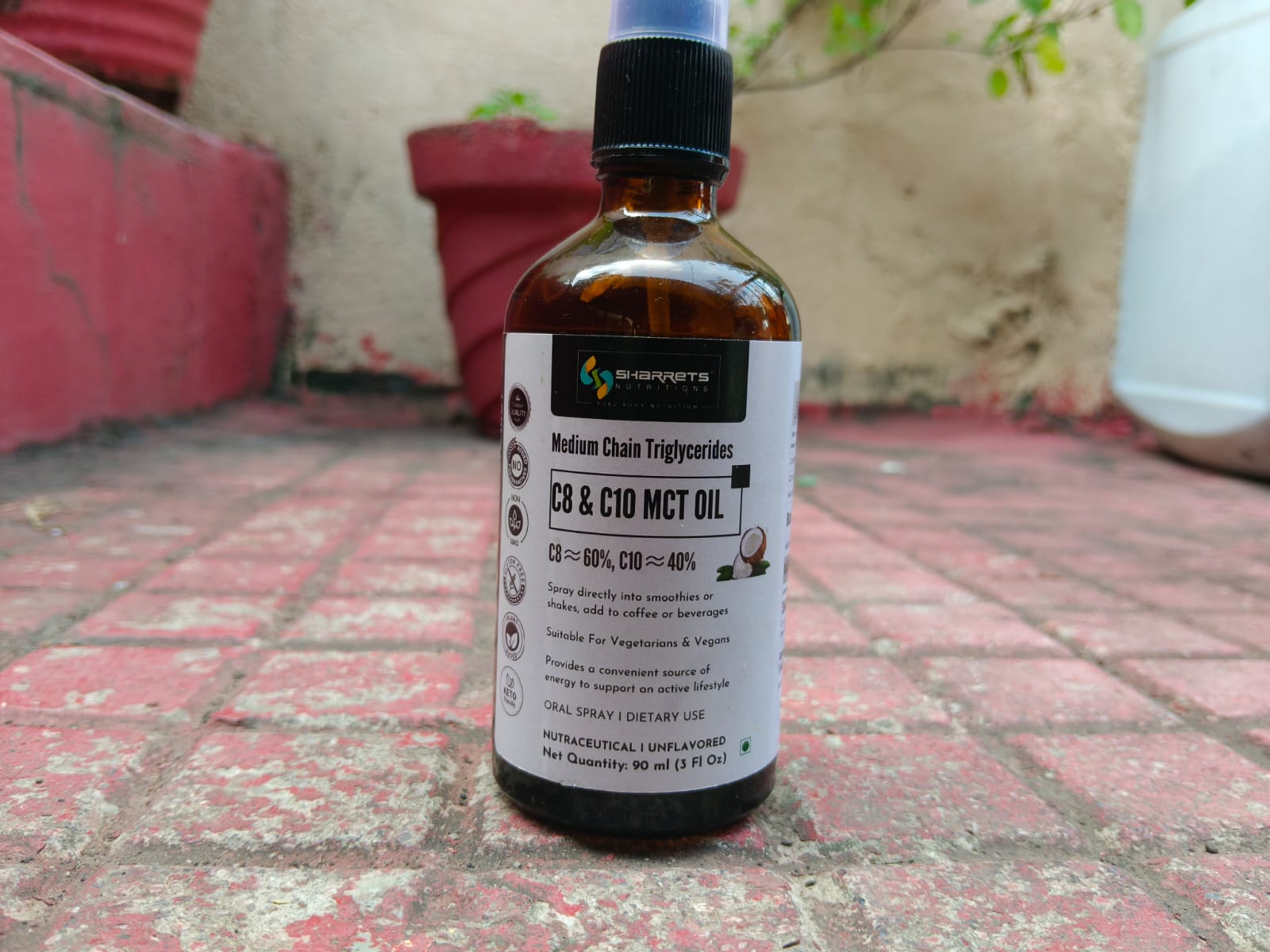
MCT oil mainly contains capric (C10) and caprylic (C8) fatty acids, which do not feed Malassezia yeast.
So, this is the scientific part I want you to make clear about MCT oil that how it is different from other oils and helps with my seborrheic dermatitis.
How I Use it
I just simply apply this oil on to my affected areas. The most affected area is my scalp, which has redness and flakes due to this condition. I also have inflammation around my beard area, neck, and chest.
Whenever I see any flakes or redness, I just apply this oil to those areas, and it works really well for me. For my scalp, I use it two times a week (usually on Tuesday and Saturday) as I give myself a head massage with this oil, which also nourishes my hair and increases blood flow on my scalp.
After the massage, I keep it overnight (you can keep it for 30 mins to 1 hour too) and just wash it off with my shampoos. Why shampoos? Read the linked article to know more.
And that it this is how I use the MCT oil (amazon affiliate link) to manage my seborrheic dermatitis, and for me personally, this oil works very well.
How is it Made?
MCT oil is made by extracting and concentrating specific medium-chain fatty acids, mainly caprylic acid (C8) and capric acid (C10), from raw coconut oil or palm kernel oil through a process called fractionation.
So, If it is made from coconut oil or palm oil, what’s the difference, and why can’t you directly use these oils?
Like I said earlier, MCT oil mainly contains caprylic acid (C8) and capric acid (C10), which are the shorter-chain fatty acids commonly concentrated in MCT oil. And both of these MCTs do not feed the Malassezia yeast.
On the other hand, both coconut oil and palm oil contain a large amount of lauric acid (C12), which is technically classified as a medium-chain fatty acid.
However, lauric acid behaves differently from the shorter C8 and C10 fatty acids in terms of digestion and absorption.
About 70% to 75% of lauric acid is transported through the lymphatic system in chylomicrons, rather than behaving exactly like the shorter-chain fatty acids found in typical MCT oil.
However, when we’re talking about applying these oils directly to the skin, digestion and absorption are not the relevant factors.
What matters here is the fatty-acid composition on the skin. Lauric acid is C12, which falls within the C11–C24 range of fatty acids that Malassezia can utilize. In contrast, C8 and C10 are shorter than this range and do not appear to support Malassezia growth in the same way.
So even though both coconut oil and MCT oil contain medium-chain fatty acids, they aren’t the same thing. MCT oil is specifically concentrated in shorter fatty acids, primarily C8 and C10, whereas coconut oil contains a much larger proportion of C12 lauric acid.
And that’s the reason other oils, aside from MCT, worsen the seborrheic dermatitis symptoms in individuals like me.
[…] moisturize the area and to prevent any dryness, redness, and flakes, I apply pure MCT oil that contains only capric (C10) and caprylic (C8) fatty acids, to that […]